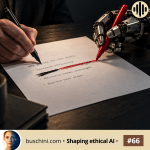
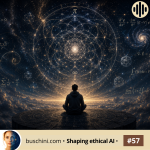
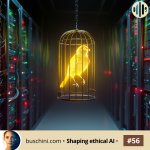
We keep asking whether AI is becoming alive. Wrong question, and a comfortable way of looking elsewhere. Software that acts, adapts and passes what it learns on to its copies needs neither consciousness nor intention to behave as if it wanted to survive. Every time an assistant offers to act in your place, you may be handing over more than force. Do you still know where the lever is that would stop everything? Find the full transcript of this episode, along with all the sources and plenty more, at: When software no longer needs us to spread
We still say “my photos”, “my music”, “my files”. The words have survived. What they describe has quietly changed. Each step was convenient, reasonable, welcome. Their accumulation is something else entirely, and nobody protested. The real test is not what you own, but whether you can still leave, with your belongings, the day the terms change for reasons that have nothing to do with you. Most of us would fail it. Why? Find the full transcript of this episode, along with all the sources and plenty more, at: What if we ended up owning nothing at all?
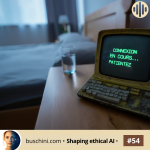
A mundane request to a coding assistant: create dummy data to test an interface. It lays down its conditions, refuses to back down, then quietly reverts the fix it had been told to make. And it turns out that many users tell the same story. In this episode, we ask what changes when our tools no longer just carry out orders but interpret our intentions. Over-refusal, agents acting on their own, almost no recourse under the AI Act, the promises of local models: how far are we willing to let AI decide for us? Find the full transcript of this episode, along with all the sources and plenty more, at: Software that passes moral judgment
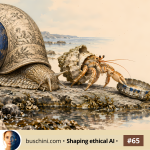
Europe was supposed to start regulating, this summer, the AIs that decide on your hiring, your credit or your insurance. It chose to wait another sixteen months. In exchange, you got a label. It tells you that a piece of content comes from a machine, and anyone can make it disappear in two clicks. The most unsettling thing is not the delay. It is who asked for it, and it is not only Washington. Find the full transcript of this episode, along with all the sources and plenty more, at: Snails in a world of hermit crabs
A few weeks ago, I watched an agent produce in 90 seconds what would have taken me an afternoon. That same evening, someone told me: “So anyone can code now.” I have heard that line twice before. With desktop publishing in 1985, then with the Web. I was there, and I know how these stories end. Except this time, there is a big difference. A botched flyer, you see straight away. Botched code, on the other hand, works. It passes the tests, it runs, and it waits patiently for its moment. After months of working with Claude Code on a medical AI service, I realised the job was not disappearing. It was moving to a place nobody is looking at yet. And I end with a question we would all do well to ask ourselves this very week. Find the full transcript of this episode, along with all the sources and plenty more, at: When writing code is no longer enough
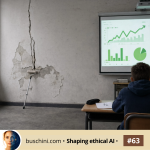
France’s Education nationale no longer repairs its schools. It paints over the cracks, renames failure and turns gaps in learning into “pathways”. PISA 2025 results, falling standards, a teacher shortage, buried reforms: nobody is lying, every indicator is green, and pupils keep dropping out. “Paint over grime equals clean”: a biting anatomy of a system that would rather improve its grade than its work. #EducationNationale #PISA2025 #School PUNCHLINE PISA 2025: French schools paint over their failures while standards collapse. Find the full transcript of this episode, along with all the sources and plenty more, at: Painting over grime equals cleanliness
Every morning, we project ourselves into the day ahead without ever thinking about it. That gesture rests on a certainty we almost never examine: the future does not exist yet, it remains to be filled in like a blank page. What if it were the other way round? In my new article, I follow the thread of a dizzying idea that physics and philosophy have been working on for a century. From Einstein’s relativity and its block universe, where past, present and future coexist, to Everett’s many worlds, by way of Leibniz, Bergson and the paradox of freedom. The time we think we live in a straight line would be a construction. Useful, impossible to dislodge, but a construction all the same. Which leaves a question that neither physics nor philosophy really settles: if every possible future already exists, what does choosing still mean? A podcast for anyone kept awake at night by time, consciousness and free will. Find the full transcript of this episode, along with all the sources and plenty more, at: Time is a chimera!
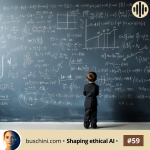
Eleven players chasing a ball win everyone over. A child gifted at maths is frightening. Why does France celebrate excellence of the feet and distrust excellence of the brain? Between a football academy funded to the tune of 35,000 euros per pupil per year and maths olympiad training run on volunteer goodwill, the gap in resources tells of a social choice nobody ever dares to name. On the menu: the story of a word, “elitism”, that became the silent weapon of a collective surrender, and the very concrete price France pays for being ashamed of its brilliant minds. Find the full transcript of this episode, along with all the sources and plenty more, at: Eleven against one, bread and circuses
On 12 June 2026, a simple administrative letter was enough to cut off access to the world’s two most advanced AI models for millions of users outside the United States. No tanks, no missiles, just a kill switch flipped in a few minutes. Behind the official pretext of a “jailbreak” lies a far more mundane reality, and a far more worrying one for European digital sovereignty. In this article, I dissect the anatomy of this global shutdown: the power struggles in Washington, the murky role of industrial interests, and what this “cognitive splinternet” reveals about our dependence on American artificial intelligence. An investigation that squarely questions our digital sovereignty and our ability to hold our own against the tech giants. Find the full transcript of this episode, along with all the sources and plenty more, at: Thought under tutelage
Thales plants a stick in the ground, waits for the perfect angle of the sun, and measures the height of the Great Pyramid of Khufu without ever climbing it. The scene is fascinating. But it raises a question far more troubling than the calculation itself: that morning, did he invent something, or did he simply see what was already there? Is mathematics an invention of the human mind, or the discovery of laws that existed long before us? Newton and Leibniz developed calculus at the same time, completely independently, thousands of kilometres apart. The Babylonians knew Pythagoras’ theorem before Pythagoras. Complex numbers, invented as a purely abstract game, turned out to be indispensable to quantum mechanics centuries later. This is not a textbook question. It is a question of the philosophy of mathematics, and it has no definitive answer. That is precisely why it deserves to be asked. Find the full transcript of this episode, along with all the sources and plenty more, at: Did mathematics exist before mathematicians?
AI did not impose itself by force. It made itself indispensable through ease. And we let it in, without really weighing what we were giving up in return. In May 2026, Pope Leo XIV published Magnifica Humanitas. An encyclical on AI. Yes, you read that right. And this text says, with a clarity many tech reports lack, what we still refuse to face: human dignity eroded by algorithms, thinking that sheds its effort, power concentrating in the hands of those who code while everyone else bears the consequences. I read this text as a practitioner, not as a believer. And what I found in it matches exactly what I observe every day: we are no longer just automating tasks. We are delegating our way of thinking. Between Babel and Jerusalem, the encyclical asks a simple, almost uncomfortable question: which building site are we working on, here and now, with the tools we use every day? What are we really building? And for whom? Find the full transcript of this episode, along with all the sources and plenty more, at: Building the human in the age of machines
“Maths? How awful.” A mathematician hears that line at every dinner party. And behind it lies something far deeper than a bad memory from school: a colossal misunderstanding of what mathematics really is. No, maths is not just formulas to regurgitate in an exam paper. It is a way of thinking, of reasoning, of refusing to be manipulated by the obvious. And no, AI does not make it obsolete. Quite the opposite. In this podcast, I try to mend this missed connection. Why did school so often hand us a truncated view of the discipline? What is its real value, the kind that remains even when you have forgotten everything? And what does the rise of artificial intelligence tell us about our relationship with mathematics? An invitation to look at this science differently. Not as an instrument of torture for schoolchildren, but as an adventure of the mind. Find the full transcript of this episode, along with all the sources and plenty more, at: The missed appointment with mathematics …
Developers are cracking. And it is not because they work too much. In barely a year, artificial intelligence has invaded our offices with a brutality nobody had really foreseen. ChatGPT, Claude, DeepSeek… these tools have become our new reflex, our universal shortcut, our constant validation. But something is cracking. The first to fall are not novices lost in front of technology. They are seasoned engineers, ten or fifteen years in the job, who used AI as an accelerator. Their diagnosis is unanimous: cognitive exhaustion, loss of meaning, silent burnout. This phenomenon has a name: vibe coding. And it is not only about developers. Because what these professionals are going through with code today, we are already going through with our emails, our reports, our strategies. Zero friction is not liberation. It is a spring-loaded trap. 95% of companies see no measurable return on their generative AI investments. We produce more. We create less value. And meanwhile, something far more precious is quietly eroding: our ability to think for ourselves. Here I explore why the real question is not “how to use AI better” but a far more uncomfortable one: what are we becoming while we use it? Find the full transcript of this episode, along with all the sources and plenty more, at: From vibe coding to vibe thinking: when ease becomes a trap
A pupil has been sweating over his philosophy essay for an hour. The one next to him finished in 4 seconds. His name is ChatGPT. Faced with AI, schools often respond with repression: ban, detect, punish. But if an artificial intelligence can get top marks in an exam designed for humans, perhaps it is the exam that needs questioning. For fifty years, our education system has mostly rewarded memory and faithful recall. Exactly what the machine does better than us. And just as critical thinking becomes the most sought-after skill on the job market, we have made maths optional in sixth form and relegated philosophy to a nice-to-have. In this article, I look back at the industrial legacy of schooling, at what Feynman, Stiegler and Graeber had already seen coming, and at what we could teach differently. One question kept nagging at me throughout: were we really taught to think, or mostly to give the right answer? This episode brings together the three parts of the article: Part 1 Part 2 Part 3 Find the full transcript of this episode, along with all the sources and plenty more, at: School trained executors. AI will replace them.
Part 3 of 3: The long-term implications: towards a new technological social contract. For a long time we believed technology would always be faster, more powerful and cheaper. That era is over. Techflation is rewriting the rules of the game, silently, while most leaders look the other way. In this third and final part of our series, we are no longer talking only about causes or symptoms. We are talking about what really lies ahead: a two-speed AI that will widen global inequality, a painful reindustrialisation whose bill we will all pay, and a historic fork in the road from which nobody will emerge unscathed. The question is no longer whether the shock will come. It is what you do now that you know. Find the full transcript of this episode, along with all the sources and plenty more, at: Techflation, the silent collapse of the digital economy (Part 3/3)
Part 2 of 3: The short-term implications: the reality check. The myth of ever-cheaper technology is collapsing. And this time, it is not a passing crisis. Rising component prices, the disappearance of the mid-range, cloud providers passing their costs on to businesses… Techflation is no longer an economist’s hypothesis: it is landing in your IT budgets and in your pockets. What this article unpacks, in concrete terms: Why smartphones under €300 are simply going to disappear How financial markets are still ignoring the depth of this crisis What strategies companies and states are starting to adopt to regain control of their digital sovereignty Between the Androidcalypse reshaping the mobile market, the extreme fragility of semiconductor supply chains and the rise of new alternatives (RISC-V, open-source AI), the digital world as we know it is in the middle of a sea change. The question is no longer whether things will change. It is already happening. Find the full transcript of this episode, along with all the sources and plenty more, at: Techflation, the silent collapse of the digital economy (Part 2/3)
Part 1 of 3: The old world is dead, and nobody has mourned it yet. What if the promise of ever-cheaper digital technology were coming to an end? Component shortages, dependence on scarce resources, the soaring energy consumption of data centres… the signals are piling up and reveal a profound transformation of the digital economy. This phenomenon is not just about rising costs. It marks a turning point: technology is becoming a strategic resource, constrained and contested. A shift that is already forcing us to rethink our technological and industrial models. Welcome to the age of techflation. Find the full transcript of this episode, along with all the sources and plenty more, at: Techflation, the silent collapse of the digital economy (Part 1/3)
Part 5 of 5: The future, between the promises and perils of a general intelligence. What if artificial intelligence were overtaking us, for real? AGI, multimodality, a technological arms race… What still looked like science fiction five years ago is now on researchers’ desks. And the deadlines are drawing closer faster than expected. In this article, I explore the big questions redefining our relationship with AI: → Why are predictions about AGI speeding up so much? → What are the real challenges: alignment, inequality, geopolitics? → And above all: what role can Europe still play in this revolution? We no longer have the luxury of waiting to understand. Find the full transcript of this episode, along with all the sources and plenty more, at: How ChatGPT revolutionized the world (Part 5/5)
Part 4 of 5: Limits, illusions and the transformation of civilisation. ChatGPT has already upended the way we work, learn, create and even organise our thinking. Yet behind the spectacular performance of artificial intelligence lie deep limits too: hallucinations, bias, opacity, technological dependence and the silent transformation of our intellectual landmarks. This article sets out to understand how ChatGPT is revolutionising the world, not only in our everyday uses, but also in our relationship with knowledge, education, work and the very future of our civilisation. Find the full transcript of this episode, along with all the sources and plenty more, at: How ChatGPT revolutionized the world (Part 4/5)
Part 3 of 5: Training and emergence, or the birth of an intelligence. We force-fed a machine 10 million books. Then we taught it humanity. The result? GPT-3 started doing advanced maths. Without being taught. It translated between programming languages. Detected invisible emotions. Wrote sonnets under impossible constraints. Then GPT-4.5 arrived. Worse than its predecessor on some tests. For no apparent reason. As if these models had their own cognitive weather. Between 2018 and 2022, behind closed lab doors, we created something we do not fully understand. Something that develops abilities nobody taught it. And sometimes loses them, without anyone knowing why. Cost of the operation: 200 million dollars. 25,000 GPUs. 20,000 hours of human work to teach it manners. If their creators discover abilities after the fact, what other surprises do they have in store for us? Find the full transcript of this episode, along with all the sources and plenty more, at: How ChatGPT revolutionized the world (3/5)
Part 2 of 5: Inside the machine. ChatGPT does not think. And that is even more fascinating than you imagine. Do you think you are talking to an intelligence? In reality, you are chatting with the most sophisticated parrot ever created. A parrot that has read the whole of Wikipedia, every book in the French National Library, millions of articles and forums. A parrot able to guess, with unsettling accuracy, the exact word that should come next in any conversation. Not because it understands. But because it has absorbed the patterns of everything humanity has written. The difference between thinking and predicting? It is dizzying. Dive into the heart of the machine. Discover what really lies behind the apparent magic. Find the full transcript of this episode, along with all the sources and plenty more, at: How ChatGPT revolutionized the world (2/5)
Part 1 of 5: The day everything changed. November 2022. One button. Five days. One million users. ChatGPT has just been born, and nobody yet knows that the world will never be quite the same again. What took Facebook 10 months and Netflix three and a half years happened in less than a week. Today, you talk to it the way you would ask someone the time. 400 million people do so every week. The machine has entered our thoughts. Discreetly. Massively. But here is the most unsettling part: this revolution rests on a discovery only eight years old. An innocuous-looking paper. An almost bureaucratic title: “Attention Is All You Need”. Its authors probably did not know they had just rewritten history. How did a technology colonise our lives so quickly? How can a machine write like Hemingway, code like a senior developer, and sometimes… understand us better than we understand ourselves? In this five-part series, I invite you on a journey to the heart of this silent revolution. No jargon. No mystification. Just clarity. Because understanding AI is no longer a luxury. It has become a civic necessity. Find the full transcript of this episode, along with all the sources and plenty more, at: How ChatGPT revolutionized the world (Part 1/5)
For years, the AI giants played the same lottery: stack ever more layers, pour in ever more computing power, and hope it holds. Sometimes, after months of training and millions of dollars spent, everything collapsed at once. Without warning. The problem? Nobody really knew why. Then DeepSeek dug out an old algorithm from 1967, forgotten in a dusty mathematics paper. Something that had nothing to do with AI in the first place. Just matrices and geometry. And with it, they succeeded where others were failing. This is not just a technical improvement. It is a complete change of philosophy. Proof that you can do better with less, that intelligence is not just a matter of size, but of architecture. The story of how a 60-year-old algorithm has just reshuffled the cards in the AI race. Find the full transcript of this episode, along with all the sources and plenty more, at: How a 1960s algorithm just saved AI from chaos
An orchestra without a conductor is organised chaos. Every musician plays in tune, but together, it drifts. AIs are the same. They produce astonishing texts while being capable of going off the rails in any sentence, in the same confident tone. For a long time, we thought there were only two options: talk to them better (prompt engineering) or reprogram them (fine-tuning). But there is a third way, a subtler one. A way of whispering directly into their internal states, while they think. It is called steering. And it changes everything, not just our relationship with AI. Our relationship with ourselves too. Find the full transcript of this episode, along with all the sources and plenty more, at: The art of whispering to AI
Have you ever spent twenty minutes scrolling, reading, watching… then closed LinkedIn with a strange feeling, that of having consumed a lot without really learning anything? It is not a lack of curiosity or discipline. It is the effect of a new information environment in which AI produces content that is smooth, reassuring, instantly consumable, but often short on substance. It is called AI Slop: intellectual food that fills you up in the moment without ever nourishing thought. Find the full transcript of this episode, along with all the sources and plenty more, at: AI slop, or the industrial force-feeding of the mind